
Fingerprint Patterns and Minutiae
This article will let you learn more about different fingerprint patterns like arch, loop, whorl, composite, accidental and ridge characteristics Minutiae which are important in comparison of fingerprints.
FINGERPRINTS
Fingerprint Patterns and Minutiae
Objectives
Types of Fingerprint Patterns
Minutia
Types of Fingerprint Patterns
Francis Galton (1892) for the first time distinguished and classified three main pattern types on fingers. They are whorl, loop and arch.
However, Henry (1900) proposed a four classification system for fingerprints. He classified the types as arch, loop, whorl and composite. It is more widely used and is the base of the modern classification system.
So mainly fingerprint patterns are:
Arches – Plain Arch and Tented Arch
Loop – Radial Loop and Ulnar Loop
Whorl – Plain Whorl and Composite Whorl
Arch Fingerprint Pattern
In this pattern, ridges enter on one side of the fingerprint pattern and exit on the opposite side.
The Arch pattern has two subtypes:
Plain Arch (A)
It is the simplest of all fingerprint patterns.
The plain arch ridges enter on one side of the impression and flow or tend to flow out on the other side with a slight rise or wave in the center.
Tented Arch (T)
Ridges enter on one side of the impression and flow or tend to flow out on the other side with a tent-like appearance in the center.
Important Point
Arches are present in only 5% of the population and are considered rare.
Loop Fingerprint Pattern
One of the most common patterns, found in 60–65% of the population.
A Loop is the type of fingerprint pattern in which one or more ridges enter on either side of the impression, recurve, touch or pass an imaginary line drawn from delta to core, and terminate or tend to terminate towards the same side where the ridge entered.
Important Feature
A loop pattern contains only one delta.
Loops are subdivided into two main types:
1. Radial Loop (RL)
It is called radial because ridges flow or terminate in the direction of the radius bone, i.e., towards the thumb of the forearm.
2. Ulnar Loop (UL)
It is called ulnar because the ridges flow or terminate in the direction of the ulna bone, i.e., towards the little finger of the forearm.
Whorl Fingerprint Pattern
A whorl is characterized by a circular pattern in which one or more ridges revolve around the core forming a complete circle.
A line drawn between two deltas crosses the curve of the whorl.
Important Points
At least two deltas are present within a recurve in front of each whorl type.
Whorls are the most complex of the three main fingerprint patterns.
According to Henry, there are two kinds of whorls:
True (Plain) Whorl
Composite Whorl
1. Plain / True Whorl
A true whorl possesses two tri-radius (deltas).
At least one ridge makes a complete circuit, which may be:
Spiral
Oval
Circular
Any variant of a circle
The ridge may revolve in clockwise or anticlockwise direction.
2. Composite Whorl Pattern
Composite patterns are compound patterns in which two or more designs, each conforming to the general aspect of one of the simpler types, are combined in the pattern area.
Characteristics
Two or more tri-radius (deltas) are present.
There are four main types of composite patterns.
Types of Composite Patterns
I. Central Pocket Loop
The line drawn between two deltas does not cross the curve of the whorl.
II. Lateral Pocket Loop
Similar to the central pocket loop but not located at the center.
It lies on one side of the pattern.
III. Twin Loop
A combination of Loop + Loop pattern.
IV. Accidentals
Very rare and occur by chance.
These patterns consist of a combination of two different types of patterns, except plain arch.
Examples include:
Whorl + Loop
Tented Arch + Loop
Triple combinations etc.
Minutia
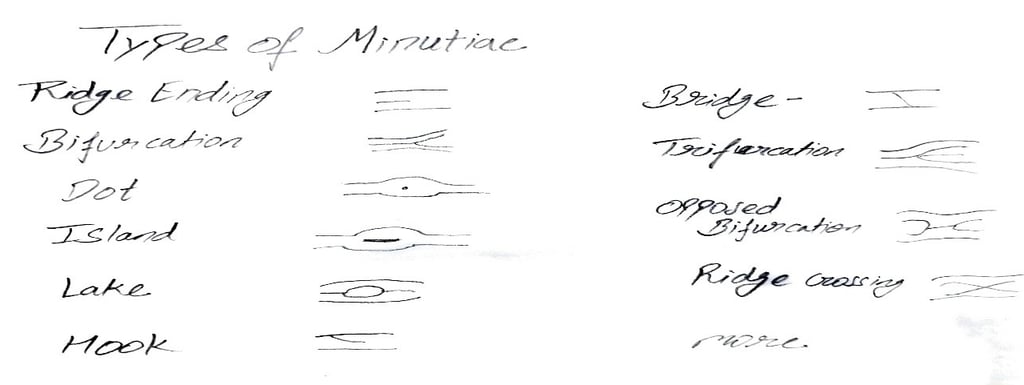
Minutiae are unique and distinctive ridge characteristics where ridges either end or abruptly split.
These points are used for individual identification in fingerprint comparison.
There are various types of minutiae, which are generally shown through diagrams in fingerprint analysis.
Locard's Principle for Fingerprint Identification
According to the French scientist Edmond Locard:
At least 12 minutiae points are required to be compared for matching a fingerprint.

Fingerprint Patterns & Minutiae: The Science Behind Fingerprint Comparison