
ABO Blood Grouping- History, genes responsible and Principle
BLOOD
ABO Blood Grouping – History, Genes Responsible and Principle
History of Blood Grouping
1900: Karl Landsteiner's Breakthrough
Austrian immunologist Karl Landsteiner discovered that mixing blood from different individuals could cause agglutination (clumping of red blood cells).
In 1901, he classified human blood into three groups: A, B, and C (later renamed O). This was the birth of the ABO system.
1902: AB Blood Group Identified
Landsteiner’s colleagues, Alfred Decastello and Adriano Sturli, discovered the AB blood group, completing the four-type system: A, B, AB, and O.
Genes Responsible
The ABO locus is located on chromosome 9 at 9q34.1-q34.2. It contains 3 alleles i.e. IA, IB and IO or (i), O being recessive and A and B as Dominant alleles.
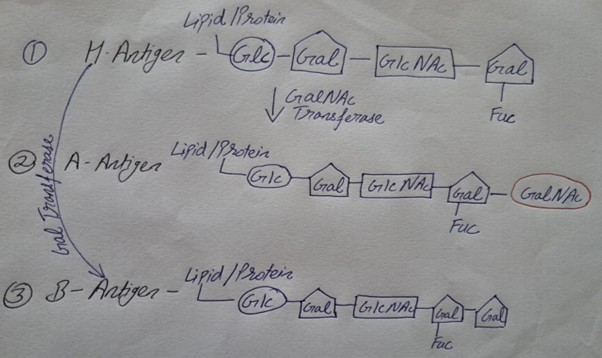
For A/B antigen synthesis to occur, a precursor called the H antigen must be present.
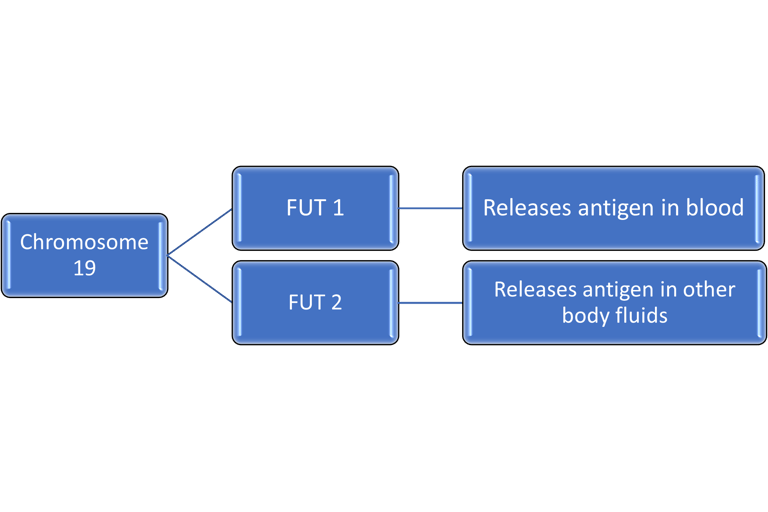
The H gene, located on chromosome 19 (locus 19q13.3), encodes an enzyme called fucosyltransferase (FUT1).
Formation of Antigens – A, B and O
Genes Responsible
Principle of Blood Grouping
The principle of blood grouping is rooted in the concept of agglutination, a reaction between antigens on red blood cells (RBCs) and antibodies in plasma.
Antigens (also called agglutinogens) are specific molecules found on the surface of RBCs.
Antibodies (agglutinins) are proteins in the plasma that recognize and bind to foreign antigens.
When matching antibodies encounter their specific antigens, they bind and cause clumping (agglutination) of RBCs.
This clumping is visible and forms the basis for identifying blood groups.
Landsteiner’s Law
First Law (Universal Principle)
If an agglutinogen (antigen) is present on red blood cells, the corresponding agglutinin (antibody) will be absent in the plasma.
Example: A person with A antigen on RBCs will not have anti-A antibodies in plasma.
Second Law (Specific to ABO System)
If an agglutinogen (antigen) is absent on red blood cells, the corresponding agglutinin (antibody) will be present in the plasma.
Example: A person without B antigen will have anti-B antibodies.
Rh Typing Principle
Based on presence of D antigen (Rh factor) on RBCs.
Anti-D serum is used:
Agglutination → Rh Positive
No agglutination → Rh Negative
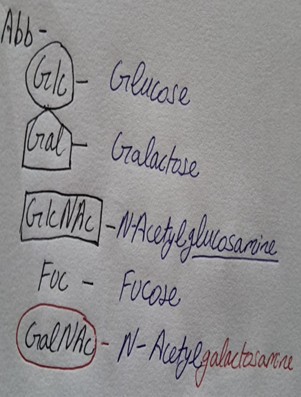
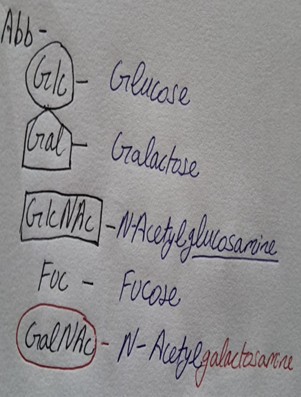

ABO Blood Grouping- History, genes responsible and Principle